
Charades Guess Game — Guessly
smak appsWord
4.6194.00 Reviews
- Version
- 1.9.0
- Installs
- 1.00M
- Age Rating
- Teen
Screenshots

Our Review of Charades Guess Game — Guessly
 Analysis by Appyee
I tried Charades Guess Game — Guessly as the kind of word game you bring out when conversation needs a little help. Its basic idea is easy to understand: one person acts, describes, or guesses while everyone else joins in. That makes it a natural fit for family evenings, casual gatherings, and party nights where nobody wants to learn a complicated ruleset first.
What makes it worth a look is not deep strategy but speed. You can start a round quickly, hand the phone to another player, and let the group create the entertainment. I found that the best moments come from the people playing rather than from the app trying to dominate the experience. That is also the main limitation: if your group is small, quiet, or looking for a solo word challenge, the appeal drops sharply.
Guessly is a free word game from smak apps, aimed at Teen users and available for Android devices running version 7.0 or later. It has reached over a million installs and holds a 4.7 average from around 36 thousand ratings, which suggests that the simple party-game format has found a broad audience. The current version is 1.5.0, and the game was released on March 30, 2026.
How Guessly feels in a real group
The first thing I noticed is how little explanation the game needs. A host can open it, choose to play, and pass the device around without turning the evening into a tutorial session. That matters with mixed groups: children, parents, friends who rarely play games, and guests who may not be comfortable with English-language game rules can all understand the basic premise quickly.
A realistic use case is a family waiting for dinner at a restaurant. One person holds the phone, another takes the guessing role, and the rest of the table supplies exaggerated clues, gestures, and laughter. The app gives the group a shared focus without requiring a television, a board, or a collection of cards. It is similarly useful during a house party when conversation has stalled but people still want something social rather than another competitive video game.
I would not treat it as a replacement for a full board-game night. A physical charades set can offer more deliberate categories, longer sessions, and a stronger sense of occasion. Guessly is better at removing preparation. You do not need to sort cards or decide who writes prompts. That convenience is its strongest everyday advantage.
The phone does create a small social trade-off. The player holding it can become the center of the round, but everyone else may end up watching one screen between turns. In a lively group that is barely noticeable. In a quieter group, the device can make the activity feel less personal than paper cards or a game played entirely through conversation.
Why the simple format works
Charades succeeds because the rules leave room for personality. A prompt can be interpreted badly, acted out dramatically, or guessed from a completely unexpected clue. Guessly benefits from that same looseness. I enjoyed it most when players stopped trying to perform perfectly and simply reacted quickly.
The game also works across different levels of confidence. A competitive player can push for fast guesses, while a less experienced participant can take a slower, more humorous approach. That flexibility is valuable for families, although adults playing with teenagers may still want to agree on suitable prompts before starting because the content rating is Teen.
One practical tip is to decide the order of players before launching into a session. Passing the phone randomly sounds spontaneous, but it can create pauses and arguments about whose turn comes next. A simple clockwise order keeps the momentum moving. Another useful habit is to keep rounds short at first. If the group enjoys the rhythm, continue; if not, the game has not consumed a large part of the evening.
What the current version tells existing users
Version 1.5.0 is the clearest marker of the app’s current state. I would read that as a product that has moved beyond its earliest release stage, but not as a promise of a major redesign or a completely different experience. The important point for a new player is that you are downloading a current build rather than judging the game solely by its launch identity.
For someone already using Guessly, the sensible approach is to update when the platform offers the current version and then check whether the game still behaves comfortably on the device. The minimum operating-system requirement of Android 7.0 keeps the compatibility bar relatively approachable, so owners of older supported phones may still be able to participate. Compatibility alone does not guarantee that every older handset will feel equally smooth, but it makes the game accessible to more households than a title requiring a recent system.
I would avoid assuming that a version number automatically means every personal annoyance has disappeared. A later build can improve stability or presentation without changing the central party-game loop. If you already enjoy quick charades rounds, the update should be viewed as a continuation of that experience rather than a reason to expect a new genre.
The release date is also useful context when judging reviews. Because the game arrived on March 30, 2026, opinions written around launch may describe an earlier point in its development than the current version. I would give more weight to recent hands-on impressions when deciding whether the present build fits your group, especially if you are sensitive to interface changes or device compatibility.
Where it fits among familiar alternatives
Compared with classic charades cards, Guessly is faster to set up and easier to carry. The phone is already in most people’s pockets, so the game can appear during an unplanned gathering. The cost of entry is also low because the game itself is free. That makes it a practical first choice for someone who wants to test the format before buying a boxed game.
Compared with general word games played alone, it is much more dependent on the people around you. A solo word puzzle can fill a commute or a quiet lunch; Guessly needs participation to reach its best form. If your priority is vocabulary training, spelling practice, or a personal score to improve over time, another word-game category will probably suit you better.
Compared with a video party game on a television, Guessly is less demanding. There is no need to connect several controllers or reserve a large screen. That makes it more portable, but also less visually impressive. I would choose it for a mixed-age group that values immediate interaction, not for friends expecting elaborate graphics, a campaign, or a large competitive system.
The free model deserves a close look before a long-term commitment. In-app purchases range from $7.99 to $49.99 per item. That does not make the initial download expensive, but it does mean that the free label should not be confused with an entirely purchase-free experience. I would start with the free version, play several gatherings, and only consider spending money if the group consistently returns to it and the paid content clearly improves those sessions.
Small decisions that improve the experience
The most effective way to use the game is to treat it as a social prompt, not as the entire evening’s entertainment. Plan a few rounds between dinner, conversation, or another activity. This prevents the format from becoming repetitive and gives people who are less enthusiastic about acting a natural break.
It also helps to separate players by comfort level. Put confident performers together when the group is competitive, but mix them with quieter players when the goal is inclusion. A person who dislikes being watched may enjoy giving guesses or helping the team more than acting alone. That kind of role adjustment is more important than squeezing every round for maximum speed.
For families, I would preview the tone of the session. Since the content rating is Teen, parents should decide whether the game’s prompts and the group’s own improvisation are appropriate for younger children. Even when the app itself is harmless in a particular round, players can steer a word game toward jokes or subjects that do not suit everyone present.
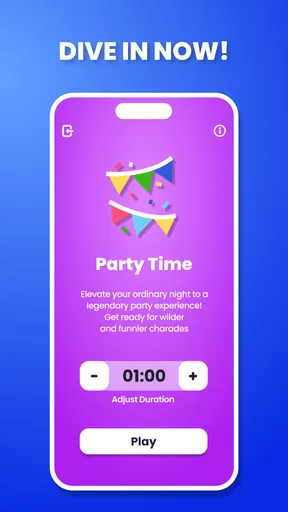
For parties, use a visible timer from the start if the app’s own pacing does not keep everyone moving. This is a simple workaround for a common charades problem: one player spends too long explaining, while the rest of the group loses energy. Short, decisive turns create more laughter than a single overextended attempt.
What may frustrate you
The biggest weakness is built into the format: Guessly cannot manufacture chemistry. With three people who are tired, reluctant to perform, or unfamiliar with one another, the game may feel like work. A deck of cards can sometimes survive that situation because the physical objects create a stronger sense of structure. Guessly relies more heavily on the group’s willingness to participate.
The phone-based presentation can also be awkward when several people want to see the prompt or control the next turn. I found that assigning one person to manage the device reduces confusion, but it makes that person less involved in the performance. In a large group, the host should position the screen carefully and announce turns clearly rather than assuming everyone can follow the action.
Another trade-off is the purchase model. A free starting point is welcome, but the listed per-item range reaches $49.99, so I would be cautious about buying impulsively during a party. The right question is not whether an extra item looks attractive in isolation; it is whether your particular group will use it repeatedly. If you only expect one evening of play, staying with the free experience is the safer choice.
I would also skip it if you want detailed progress tracking, a serious competitive ladder, or a rich offline puzzle experience. Nothing about the game’s central identity suggests that those are its main goals. Its value is immediate group interaction, and judging it by the standards of a solo word-training app would lead to the wrong conclusion.
Who should download it
I recommend Guessly to people who regularly host casual gatherings and want a low-effort activity ready on a phone. It is especially suitable for families with teenagers, friends who enjoy acting out silly ideas, and groups that prefer conversation over complicated game systems. The free entry point makes it easy to test without first buying a dedicated party box.
I would be more selective for solo players, very small groups, and anyone who dislikes being on camera or performing in front of others, even though the activity itself does not require a formal stage. If you want a word game for a commute, a quiet evening, or personal improvement, choose a solo-focused alternative. If you want a polished console-style party production, choose a game built around a shared screen instead.
There is also a question of language and audience. Charades can cross language barriers better than text-heavy quizzes because gestures carry much of the meaning, but the actual prompts still influence how comfortable a group feels. For a multilingual gathering, I would test a few rounds first and see whether everyone recognizes the words quickly enough to keep the game fair.
What I would watch as the game develops
The next meaningful improvements would be the ones that reduce party friction: clearer turn handling, better ways to keep a group moving, and content organization that helps a host choose an appropriate tone. I am not treating those as confirmed additions; they are simply the areas that would make the biggest difference in real use.
I would also watch how the current version affects returning players. A successful party game needs enough freshness to justify opening it again, while still remaining simple for first-time guests. If future updates preserve that balance, Guessly can remain useful beyond a single novelty session. If updates focus mainly on purchases without improving variety or flow, existing users may have less reason to return.
The ratings provide encouraging context, with a 4.7 average supported by around 36 thousand ratings and 115 written reviews. I see that as a positive signal, not a guarantee that every group will enjoy the same experience. Party games are unusually sensitive to audience, room energy, age range, and expectations. A high average can tell me that the concept works for many people; it cannot replace trying it with my own friends.
My final view is that Charades Guess Game — Guessly succeeds by staying approachable. It is free to start, quick to explain, and well suited to a spontaneous group activity. The current version 1.5.0 gives new and existing players a clear point of reference, while the Android 7.0 minimum keeps it within reach for many older devices.
I would download it before a family visit or casual party, but I would keep expectations realistic. It is not a substitute for a deep word puzzle, a full board game, or a major multiplayer production. It is a pocket-sized way to get people acting, guessing, and laughing with very little preparation. If your group supplies the energy, Guessly gives that energy a simple structure.
Privacy and Permissions
See what permissions an app requests and how it handles your data.
- Photos/Media/Files
- read the contents of your USB storage, modify or delete the contents of your USB storage
- Storage
- read the contents of your USB storage, modify or delete the contents of your USB storage
- Camera
- take pictures and videos
- Microphone
- record audio
- Other
- view network connections, full network access, change your audio settings, run at startup, draw over other apps, control vibration, prevent device from sleeping, Google Play license check
Verdict
Strengths of Charades Guess Game — Guessly
- Quick rounds make it easy to play during parties or short breaks.
- Simple gestures and guessing rules are accessible for all ages.
- Supports lively group interaction without requiring complex setup.
- A broad mix of prompts helps keep repeated games entertaining.
- Works well as a screen-free activity once the prompt is shown.
Limitations of Charades Guess Game — Guessly
- Some prompts may feel repetitive after several sessions.
- The experience depends heavily on having an energetic group.
- Background noise can make spoken guesses difficult to hear.
- Certain categories may not appeal to every player.
- Ads or in-app purchases may interrupt the flow of play.
Other Releases by smak apps
View All
Fakeit: Imposter Game
Word4.6
Similar Picks in This Category
View All
Word Search - Word Puzzle Game
Bluetile4.8

Word Search Quest - Puzzles
Blackout Lab4.8

CodyCross: Crossword Puzzles
Fanatee, Inc.4.7

Words of Wonders: Crossword
Fugo Games4.9

Wordscapes: Word puzzle game
PeopleFun4.7

Word Search Explorer
PlaySimple Games4.9
Frequently Asked Questions
What is Charades Guess Game — Guessly, and how does it work?
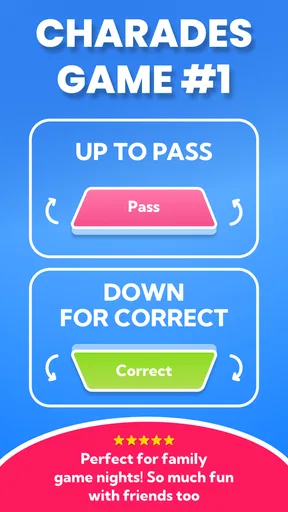
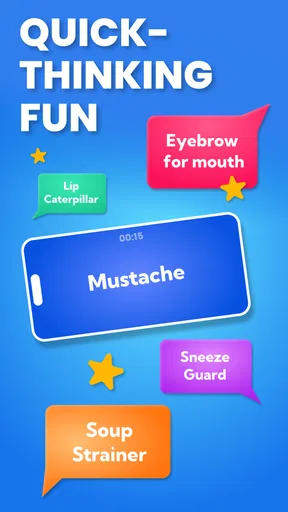
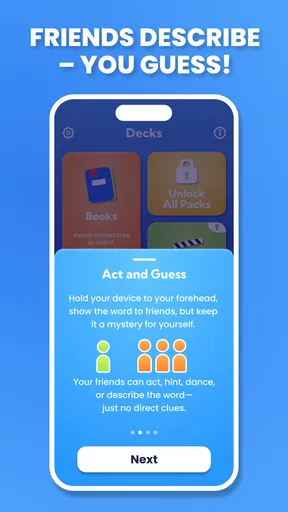
Charades Guess Game — Guessly is a party game in which one player holds the phone near their forehead while the other players give clues, act, or describe the word displayed on the screen. The person holding the device tries to guess the answer before the timer runs out. Depending on the selected mode, players may tilt the phone to mark an answer as correct or skip it, making the game fast and easy to play in groups.
Can I play Charades Guess Game — Guessly without an internet connection?
The core charades experience may be available offline once the necessary game content has loaded, which is useful for parties, trips, or places with limited connectivity. However, some features can depend on an internet connection, including advertisements, additional category downloads, updates, analytics, or certain online options. It is best to open the app before playing and confirm that your preferred decks are accessible offline.
Does Charades Guess Game — Guessly include different categories and difficulty levels?
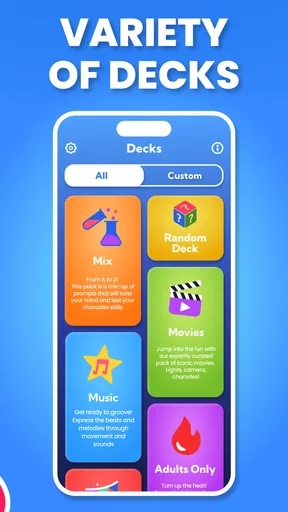
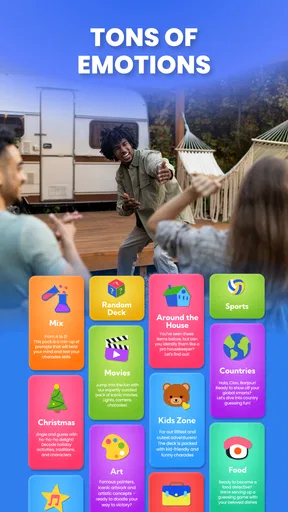
The game is designed around themed word decks so players can choose content that suits their group. Categories may cover subjects such as movies, animals, actions, food, celebrities, or everyday objects, although the exact selection can vary by version and platform. Some decks are more accessible for children and casual players, while others may require broader knowledge or more creative clues.
Is Charades Guess Game — Guessly suitable for children and family gatherings?
Charades Guess Game — Guessly can be a good choice for family gatherings because the rules are simple and most rounds rely on acting, gestures, and verbal clues rather than complicated controls. Parents should still review the available categories and any displayed advertising, since word themes and ads may not always be appropriate for every age group. Younger children may also need help reading the prompts.
Is Charades Guess Game — Guessly free to download, and are there in-app purchases or advertisements?
The app can generally be downloaded without an upfront purchase, but free access may be supported by advertisements or limited content. Depending on the version, additional categories, ad removal, or premium features may require an in-app purchase. Before starting a game, check the store listing and the app’s purchase screen carefully, especially if children will be using the device or making selections.
Play our best games!


